Wednesday, 2 December 2015


Carbon emissions in Malawi


Villagers in southern Malawi display their prototype cook-stoves.
Concern Universal (2014). Malawi cookstoves. Photograph. At: Malawi: Irish Aid, [On Line] Accessed 28.11.2015. https://www.irishaid.ie/news-publications/news/newsarchive/2014/november/president-visits-cookstove-programme-malawi/.
 

Reading through an issue of New Scientist (21/11/15, issue number 3048) an article caught my attention.  Titled; ‘Up In Flames’, by Roger Harrabin, printed on page 26 - 27 of the magazine and discussing Africa in relation to climate change.  

The article is discussing Malawi and how, as Harrabin describes it, “pledges to curb carbon emissions in parts of Africa could falter given the hurdles ahead.” (Harrabin, 2015).   He describes how most electricity is derived from either solar power or hydropower.  Which at face value seems very 'green' indeed, however Harrabin goes on to explain that the country has one of the highest levels of deforestation in the world.  These trees are then often used for fuel for cooking, this also leaves exposed ground so along with less of our green leafed friends to take up CO2 from the atmosphere, the exposed ground also releases CO2. 


Deforestation, Mount Mulanje, Malawi
Marie-Marthe Gagnon (2009). Deforestation, Mount Mulanje, Malawi. Photograph. At: Mount Mulanje, Malawi: ©2008 Marie-Marthe, [On Line] Accessed 28.11.2015. https://www.flickr.com/photos/marie-2008/3297447049/in/gallery-123430817@N08-72157644144360746/.

The article also discusses issues of exposed soil in relation to surface water run-off, and how this affects rivers and aquifers as well the fact that surface water run off washes sediments into water systems that can then block and damage hydropower stations.  But this page is about CO2 and global temperatures, so I’ll skim over that information.  However it does come full circle to impact on the CO2 emissions, as unrealisable hydropower supplies means power black outs.  The country are now discussing the building of two new coal burning power stations to tackle this power short fall, effectively increasing the CO2 output.  However, in light of the upcoming COP21 summit in Paris the country is pledging to tackle deforestation, and introduce effective stoves to the tune of 2 million by 2030 to reduce wood burning by half. 

Malawi are asking COP21 for assistance with the stove scheme implementation and tree planting programs, but unfortunately with an estimated population of 40 million by 2040 these stoves could have little impact on reducing wood fuel use. 

It may appear to a bystander that issues of CO2 emission reductions and renewable energy sources at face value seem simple to manage, sadly it is not as simple as installing a solar panel and cutting down less trees.  The growth in population also must be considered in order to meet the needs of that population and reduce the impact on the environment, it is an incredibly complicated issues with no quick fixes. 

Reference;
Harrabin, R (2015). Up In Flames. New Science, 21st November 2015, p.26 - 27.

Saturday, 14 November 2015

Is It Getting Hot In Here?

In my first post I said that I was reading the book Six Degrees, Our Future On A Hotter Planet, by Mark Lynas.  I also shared a link to the authors webpage , on this page it states that the book had been made in to a documentary by National Geographic. This is a very interesting, thought provoking program that (purely for educational purposes) I share here.   All material and rights belongs to National Geographic and the video is available on YouTube. 
 
 
So rather than take my word for it, you can watch it yourself and formulate your own conclusions. 
 

Thursday, 12 November 2015


CO2, Natural & Anthropogenic

As any basic chemistry book will tell you, CO2 is an odourless, colourless gas.  The compound itself consists of a carbon atom and two oxygen atoms, but I’m not here to give you a chemistry lesson and I am quietly confident that this is incredibly familiar information.  But where does the CO2 in the atmosphere come from?  Sources of atmospheric carbon dioxide can be categorised as either natural or anthropogenic.  Even a basic illustration of the carbon cycle can highlight this nicely.


As you can see there are a number of sources of atmospheric CO2 including plant and animal respiration, organic decomposition , volcanic outgassing/eruption as well as anthropogenic sources, namely via combustion of fossil fuels.


According to the most recent report from the Intergovernmental Panel on Climate Change (IPCC), The Fifth Assessment Report (AR5), which was released between September 2013 and November 2014 (http://www.ipcc.ch/activities/activities.shtml).  2011 saw CO2 levels reach 390.5ppm which represents a 40% increase from the levels of 1750, which the IPCC AR5 reports to of been 278ppm.
Just as a point of interest, the AR5 also states that during the same time interval there were also increases in Methane (CH4) and Nitrous oxide (N2O) levels.  The report also states that levels of all three (CO2, CH4 and N2O) exceeded any levels measured for the past 800,000 years (http://www.ipcc.ch/report/ar5/wg1/  [Chapter 6, page 467]). 

Furthermore, the AR5 states that ice cores show that atmospheric CO2 levels for the last 7000 years preceding 1750 saw slow increases from 260ppm to 280ppm.  But CO2 levels have also seen fluctuations from 180ppm during glacial periods over the past 800,000 years up to 300ppm during interglacial periods (http://www.ipcc.ch/report/ar5/wg1/  [Chapter 6, page 468]).


Just a thought.....

As I mentioned in my first post, I am new to blogging.  But have decided to set myself somewhat of a format to my posts.  The reason for this is to allow not only myself, but also anyone who is taking the time to follow me the ability to build up a picture of the topic in hand.  With this in mind, I felt it prudent to firstly consider (if only briefly) CO2 in itself, its causes, both natural and anthropogenic and the role it plays in our atmosphere e.g. how it influences global temperatures. 

I then plan to move on to consider CO2 levels and global temperatures of the past, the present and the future projections of CO2 levels and the resulting influences on global temperatures. 

I do wonder, if as a result of this I will in time come to formulate any solid, satisfying answers to just some of my many questions relating to anthropogenically induced CO2 rises.  For example; do we have a moral obligation to the other life forms of the Earth to manage the CO2 which we produce?  Do we only manage it to save humanity or to also protect ‘nature’?  And, if we do it to protect ‘nature’ is this due to its usefulness to humanity or for its own intrinsic value?  If CO2 levels and global temperatures of past climates have varied without the action of man then should we really concern ourselves with variances as a result of our actions now? 

I do currently feel that we should hold ourselves accountable and that we should act to mitigate anthropogenic CO2 level increases and the resulting impacts upon the natural world.  Will my views changes as I delve deeper into the literature?  Surely the ‘business as usual’ approach is no longer viable?


Picture courtesy of; http://www.earthtimes.org/newsimage/co2-release-fast-environment-cope-geologists_66.jpg
 

Sunday, 25 October 2015

Introduction - Welcome.


Introduction

As part of my Masters I am undertaking a Global Environmental Change course and have been tasked with writing a blog.  This is a first for me and I am enthusiastic to see where this journey takes me. 

I have decided to consider CO2 and global temperatures of the past, present and future.  This is in part inspired by a book which I am currently reading titled Six Degrees, Our Future on a Hotter Planet, by Mark Lynas.


The book was published by Harper Collins. ISBN 978-0-00-720905-7

More information about the author and other books he has written can be found on his webpages at http://www.marklynas.org/books/

In writing his book Lynas undertook a unique piece of work, initially researching scientific papers relating to varying degrees of warming and arranging them in order of warming.  It was this research upon which he based his book.  He carries the reader from a one degree warming to, as the title suggests, a six degree warming spelling out in clear terms the possible implications of each degree of warming.  If you are unfamiliar with the book I can highly recommend it.  It is a page turner from the outset and Lynas writes with a passion and enthusiasm for the topic that draws you in.  On a personal note, I found parts of the book slightly unsettling when I was left considering the fate of life for future generations of not only humans but also all life with which we share out home.

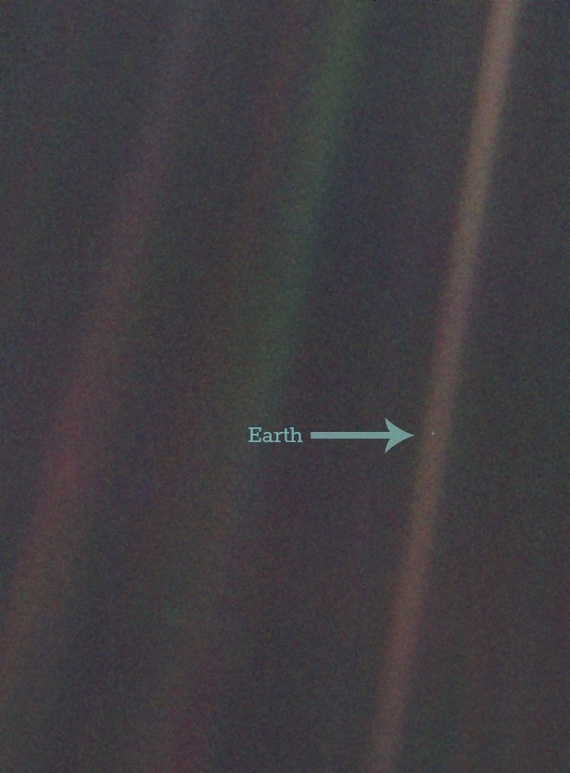
As I consider this topic one very stark image is brought to mind, Carl Sagan’s Pale Blue Dot.  I’m sure that many of you are familiar with not only the image, but also Sagan’s quote;

 
Look again at that dot. That's here. That's home. That's us. On it everyone you love, everyone you know, everyone you ever heard of, every human being who ever was, lived out their lives. The aggregate of our joy and suffering, thousands of confident religions, ideologies, and economic doctrines, every hunter and forager, every hero and coward, every creator and destroyer of civilization, every king and peasant, every young couple in love, every mother and father, hopeful child, inventor and explorer, every teacher of morals, every corrupt politician, every "superstar," every "supreme leader," every saint and sinner in the history of our species lived there-on a mote of dust suspended in a sunbeam.” 

 
It reminds me that our home, this tiny planet is a wondrous and fascinating place, complex and beautiful, yet fragile and unique.  Often we take the environmental process that take place for granted, they pass by unnoticed as we go about our daily lives. Sure we notice our local weather, here in the UK it even seems to be somewhat of a national pass time to have a good old moan about it.  But how often do we really consider the bigger processes which are at work?  How often do we think back to past climates or consider what the future climates maybe?  As our tiny life raft orbits our star we feel so secure, and climate change is something that happens a life time away, but every day in our own little way we add to the amount of anthropogenically produced CO2 which enters the cycle and adds to the ever growing amount in our atmosphere. 

I have heard so many people say that the climate has changed in the past, it’s been colder, it’s been warmer, CO2 levels have been different, so why should we care? Well this is a topic I have a great interest in exploring further and I hope that you enjoy the posts and topics I consider throughout the course of this blog and will follow me on this journey of discovery.